

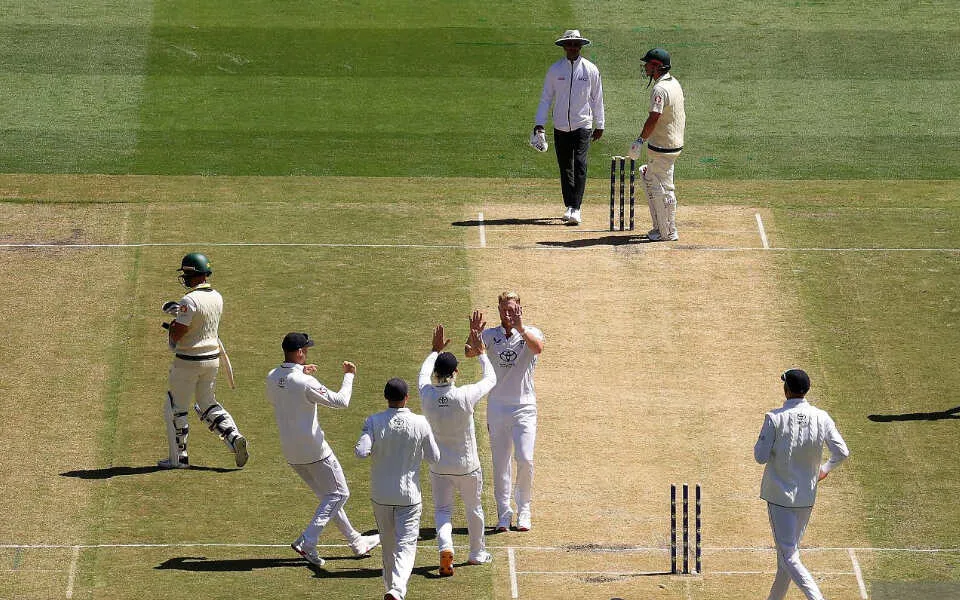
Former international umpire Simon Taufel has defended the decision to call England’s Jamie Smith out after being caught behind on review on the second day of the first Ashes Test in Perth. The wicketkeeper-batsman, who was batting on 15, was squeezed for space as he attempted to pull a back-of-a-length delivery from Brendan Doggett and was initially ruled not out by on-field umpire Nitin Menon.
Following strong protests from Travis Head at short leg and wicketkeeper Alex Carey, Australia captain Steven Smith decided to review the decision. The verdict was subsequently overturned by TV umpire Sharfuddoula, but only after a lengthy review of the original delivery.
Smith began walking away after noticing a slight rise on the stadium screen’s Real Time Snickometer (RTS). However, he paused when the slowed-down footage revealed that the spike appeared a frame after the ball had passed the bat. Despite the ambiguity and nearly four minutes of deliberation, Sharfuddoula pronounced Smith out, citing evidence that suggested contact with the bat.
Simon Taufel later supported the TV umpire’s ruling, emphasising the significance of utilising all available technology and remaining consistent in decision-making.
“[There is a] spike as the ball has just gone past the bat. [I am] satisfied the ball has made contact with the bat. My decision… Nitin, you need to change your decision from not out to out. There’s a clear spike as the ball had just passed [the bat],” said Sharfuddoula on broadcast.
Check the video of the moment here
Jamie Smith started to walk before coming back after this hotly discussed moment. So what’s your call here?#Ashes | #DRSChallenge | @Westpac pic.twitter.com/FpiqM6U6uM
— cricket.com.au (@cricketcomau) November 22, 2025
The thousands of England supporters at the ground booed the decision and chanted, ‘Same old Aussies, always cheating’. However, Taufel maintained that the correct decision had been made, pointing to the differences between edge-detection technologies used in Australia and in other parts of the world.
“This is the difficulty when we have two types of edge-detection technologies around the world. Primarily, we use Hawkeye Ultra-Edge. In Australia, it’s one of the few countries in the world to use Real-Time Snicko. It’s very difficult to come into a series with limited experience around how to judge RTS, but the conclusive evidence protocols with RTS [are that] if you get a spike up to one frame past the bat, that is conclusive. And in this particular case, that is exactly what was there,” said Taufel on Channel 7.
“Unfortunately, he [Sharfuddoula] didn’t want to pull the trigger quite as quickly as perhaps he could have or should have. And the guys in the truck were doing their utmost to show him and to slow it down and to try rocking and rolling that frame. For me, the correct decision was made: a spike [on] RTS after one frame past the bat, the batter has got to go,” he added.
The decision was reminiscent of several similar controversies during last year’s Border-Gavaskar Trophy between Australia and India. Mark Waugh said that Smith’s initial walk towards the dressing room might have influenced the decision to give him out.
“I think Smith gave it away there. I don’t think the umpire would have been convinced that he’d hit that if he’d stayed there. You’ve got to think if that takes that long to make a decision that there’s got to be some doubt there. But when Smith walked off, I think that’s what convinced the umpire. I think that’s the longest DRS decision I think I’ve seen,” said Waugh on Kayo Sports.


 India
India

