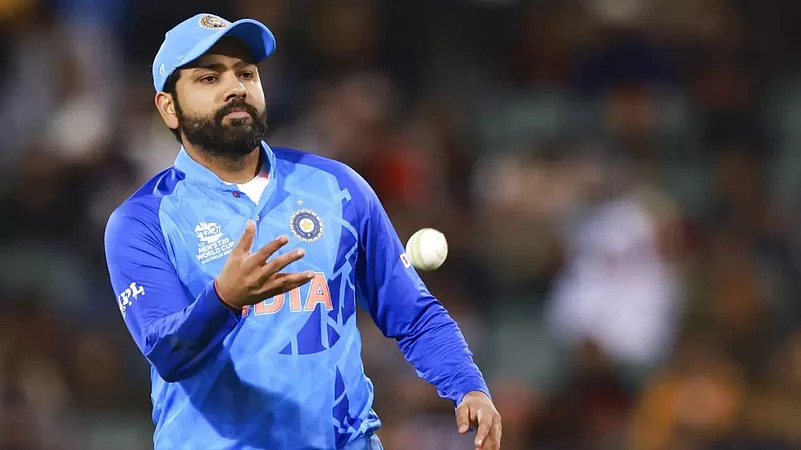
Rohit Sharma, a former captain of India, has talked about his first experience watching the forthcoming T20 World Cup from the sidelines. After leading India to the championship in 2024 and retiring from Twenty20 Internationals, Rohit Sharma acknowledged that it has finally dawned on him that he will miss a major international competition.
After the Men in Blue ended their protracted ICC trophy drought by winning the 2024 T20 World Cup, Rohit Sharma , Virat Kohli, and Ravindra Jadeja left the shortest format. Rohit will not play in a T20 World Cup for the first time in 2026, even though he and Kohli now only participate in ODIs. Suryakumar Yadav will captain India when they start their title defence against the USA on February 7 at Mumbai’s Wankhede Stadium.
In an interview with JioHotstar’s “Captain Rohit Sharma’s Roadmap for T20 World Cup,” the 38-year-old discussed how this stage feels different. He claimed that while missing bilateral games is never as painful, missing a World Cup is.
“At home, we were discussing how bizarre it will be to watch events from home, particularly the T20 World Cup. I have participated in every World Cup since it began, so it will feel different. The truth sets in when you miss a World Cup. At that point, you understand you won’t be involved. But I’ll be in the stadium somewhere.
It will be a new experience, but it won’t be the same,” Rohit Sharma remarked.
The batting mainstay also thought back on his time as captain, saying that high-level leadership frequently necessitates difficult and unpopular choices. He emphasised that one of the most challenging aspects of the job was making selection calls prior to important competitions. Rohit described how decisions were influenced by squad balance and multi-skill requirements, citing instances like Shreyas Iyer’s omission from the 2022 Asia Cup and T20 World Cup.
“Making difficult decisions prior to World Cups has happened numerous times. You can’t please everyone, but it’s crucial that each person understands the rationale behind a decision,” Rohit Sharma continued.
Rohit, on the other hand, supported the Indian T20 team’s current configuration, pointing out that continuity has benefited them. He thinks the team has gained a solid understanding over the last two years, with over 80–90% of the players remaining from the previous World Cup and an average age near 25.
 India
India