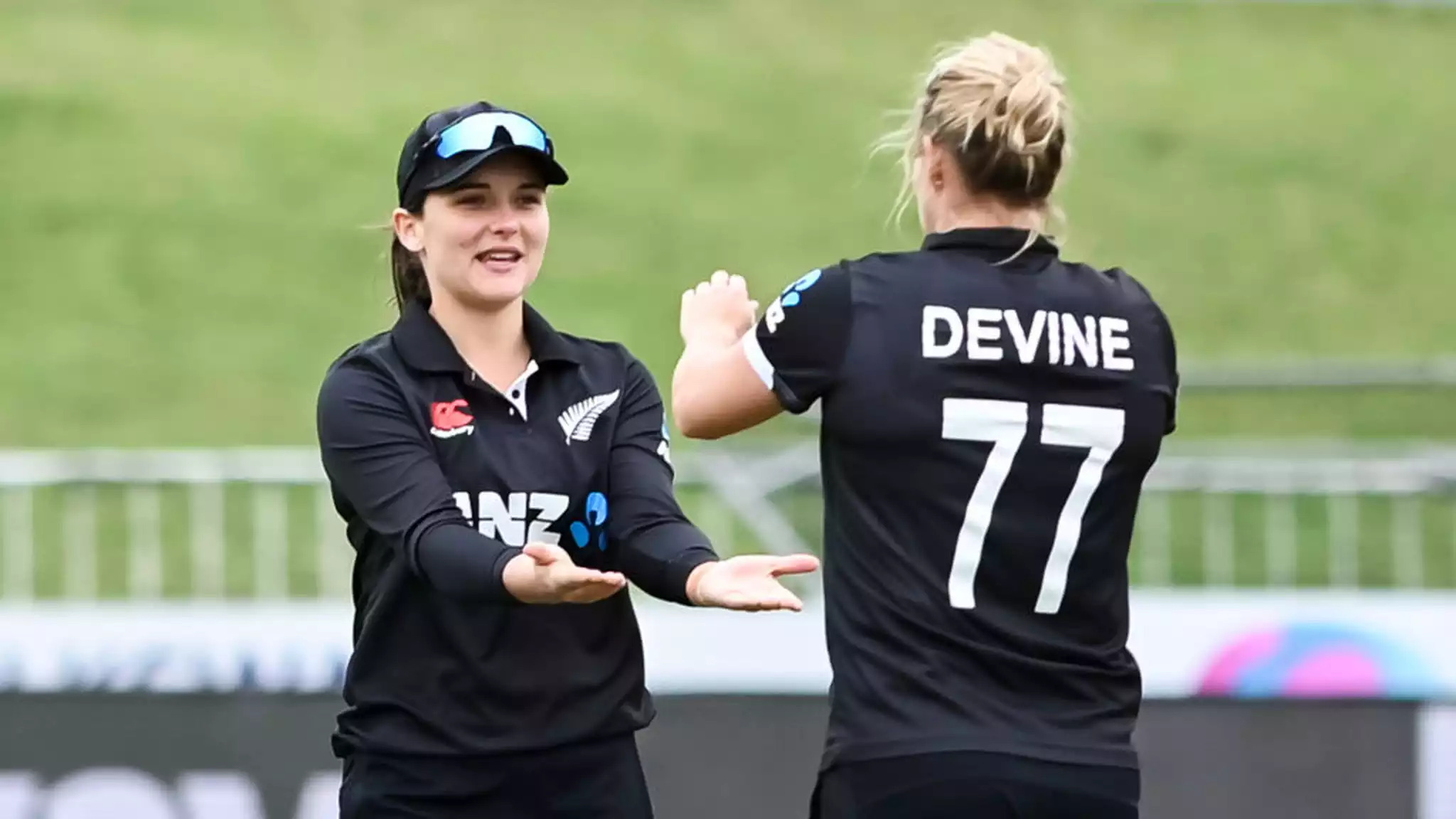
The end of an era for New Zealand cricket will occur when Sophie Devine takes the field for her final One-Day International match against England. Before the 2025 World Cup in India began, the captain made it known that she would be retiring from the format at the end of the competition; this decision now coincides with an early exit.
Sophie Devine , a formidable all-round player, a ferocious competitor, and a captain whose influence went well beyond the scoreboards, has been the face of the White Ferns’ team for more than ten years. Speaking with her teammates, however, reveals that her influence on New Zealand cricket goes far further back in time; she once looked after her teammate Amelia Kerr.
As Kerr puts it, “I think I must have been too young to remember that,” but he does recall attending to see the Wellington Blaze play as a child and, in particular, admiring her. Sometimes I would run into her at the nets where I trained, and she was always extremely kind to me. She gave me some of her batting gloves and some of her old White Ferns playing tops, I recall. She was an inspiration to me as she came from a humble background and managed to accomplish what she has since she was born and raised in Tawa, where I was raised. When I first had the opportunity to play for Wellington with her, it was a unique experience.
Sophie Devine “follow me” style of captaincy, which also influenced Lea Tahuhu, was mentioned by Kerr. The way she approaches it makes me believe that she is quite courageous. She is, in my opinion, also a really humble person. “Follow me, this is what we have to do to get a win here,” she says, grabbing a game and her team. And this is what we will have to provide. It’s really remarkable how she has managed to play through and have such a lengthy international career with diabetes.”
However, no one has been more intimately involved in Devine’s two-decade journey than comrade and close friend Suzie Bates. Together, the two have been leaders, mentors, and, as their teammates lovingly refer to them, the “grandmas” who have kept the torch of cricket in New Zealand alive. As Sophie Devine gets ready to play her final 50-overs match, Bates considers their journey together, the connection that molded a generation of White Ferns cricket players, and the legacy she leaves behind.
Before your teammates arrived, you gave Sophie Devine a lengthy embrace exactly one year ago in Dubai when you guys won the World Cup. Remember what was said at that very moment?
Bates: With this team, we have played together for a very long time and have matured into grownups. Although Sophie and I have a lot in common, we also have a lot of differences. There is a great deal of respect for Sophie’s style of play and the strain she has faced as a captain and player. I have a great deal of empathy for the extra work that goes into World Cups since I have been captain myself and have failed to win as a captain.
I believe I was at mid-wicket and she was at mid-on for the entire over. The ball was getting closer with each one. We were sort of staring at each other, wondering, ‘Is this really going to happen?’ Although we didn’t want to celebrate much. The exultation of “We’ve actually done this” was all that remained when the last ball was bowled.
She was there in 2009 and has been with me at World Cups ever since. We have been in the changing room together when we have failed, but there have been other players who have been through all those times. So, having her on the field and as captain was just so great to experience that moment and to finally feel like a winner. I was quite proud of her for leading that group.
Even though it will be weird for both of us to be apart, I have no doubt that we will maintain our communication and have many happy memories together. However, it was only a hug. We may have simply exclaimed, “Oh my God, oh my goodness, we did it!”
When you two first became international teammates, what was the basis for your connection, if I may ask you to go back 20 years? And how has that relationship changed over time to become the wonderful professional and personal rapport that you two share?
To be completely honest, it was likely a highly competitive relationship at the beginning. She was a domestic athlete who was about my age, and I believed she was the best young player in the nation. I wanted to do better because I wanted to be the best, just as she did. Since we both played a different sport and were all-arounders, it was kind of a race against the clock to stay up with her, as well as a challenge to improve our fitness and other things [like that] early on. Then it developed into a desire to advance the team by becoming the best players we could be.
As a young person, you’re sort of thinking, ‘Oh, who’s the best young thing going around?’ But as you get older, the focus shifts to the team. The group has become more competitive as a result of us bringing our most competitive selves, which I thought would be beneficial. We remain the ones at the gym in the event of competition. We are the ones attempting to win, but in a really healthy way, even though we may not move as well as we once did. I believe that we want to leave this group wanting to compete at every ball, but not so that we can be the best, but so that the White Ferns can improve as a team.
After starting out as a fast bowler, Sophie Devine went on to become one of cricket’s most reliable all-round players and even a World Cup-winning captain. Have you been inspired by any aspect of this development and progress, or have you witnessed some of your teammates draw inspiration from her path?
She talks about how she and Melie [Amelia Kerr] both began batting in the White Ferns at the age of nine or ten. I started the second game at the top of the order, but my first game was at nine. I was a little different. However, those two speak to players like Eden Carson and Jess Kerr about their desire to be all-around players who can contribute with both the bat and the ball. Melie and Sophie Devine are the best all-round players we’ve had in the past ten years, so some of our other ladies are motivated to move up the order if they’re batting at nine.
However, Sophie Devine difficult runs are what really stand out to me. In the last two 50-over World Cups, she scored the majority of our runs, according to a statistic. I find it inspiring that even though she can take a break from playing, she gives it her best on the field during these World Cup competitions for New Zealand. She truly sets an example by putting her all into this team and has really come through for us at World Cups.
What is the most notable aspect of Sophie Devine influence on cricket in New Zealand over the course of almost 20 years?
everything’s difficult for me to sum everything up, but I am convinced that I will always remember the manner she has played cricket and intimidated opponents. Knowing that the bowler does not want to miss makes you ten feet taller when you can bat or open with a player like Sophie Devine.
to maintain her brand, play that fearless cricket, and have the flexibility to adjust to various circumstances. People often think about Sophie Devine because of her destructive nature and the way she set an example by always playing in that way. Whatever she was doing, she knew that if she hit the ball hard, the other team would be on the defensive, and the game would be on the defensive as well. It may be for the best that we won’t generate another Sophie Devine, but I’m sure we’ll produce more players that hit the ball hard.
What impact do you think Sophie Devine legacy will have on the upcoming White Ferns players?
Her drive to become true all-rounders—top-order hitters who bowl quickly—is simply how she has transformed the game. Playing like Sophie Devine would be ideal if you wanted to pursue a career in cricket. She would hit sixes, hit the ball hard, bowl, and field. She is the player who is most likely going to be around for next 20 years.
Few players may be considered generational; they somewhat fit the last decade but will also fit the following two decades of the game’s development. In my opinion, there is no one better to look to if you want to strive to become a power player, which is the direction the game is taking. I believe it’s a simple method to intimidate and put pressure on the bowler, even if you lack that sheer power.
When Sophie Devine leadership genuinely embodied the values of this White Ferns squad, can you think of an instance that occurred on the field or during off-field training?
Sophie Devine and I have a lot of differences. She is also extremely calm, so I’m definitely calmer, but I’m probably softer when I speak, but Sophie shows her emotions by demanding more from the group when she wants more. She frequently takes the ball, bowls, sets the tone, and leads by example when she gives us a bit of a rack-up or is a little unhappy with what we’ve been giving up in the field. Therefore, I believe it’s just her ability to affect the game after seeing when a group is a little flat. The ability to lead from the front and deliver a few stern words when necessary is crucial for a leader. In addition to the numbers, what do you believe her legacy will be for the White Ferns and women’s sport in New Zealand as a whole?
You’ll probably remember Sophie Devine game play and her hard hitting, competitive nature, and her ability to be goofy if you knew her off the field.
I doubt you’ll remember her stats. Look, she is a captain who has won the World Cup. It’s a really awesome legacy to be a part of now that we have two White Ferns: Emily Drum and her. I simply believe that young players will be seeing that tape and thinking, “Wow, she hit the ball hard,” as I mentioned twenty years ago. And she’ll hit the ball just as hard as anyone else, regardless of how the game changes.
In what way has she been able to be both hilarious and intense at the same time?
I believe she would acknowledge that she has likely only gotten that correct in the previous five years. I believe that everything was ridiculous when she initially appeared, and coaches may have become a little irritated as they wondered if she was switched on. She was always in the fight, though, when she crossed the white line. Being captain and perhaps having expectations as a player might cause you to lose sight of your actual self, which is what makes you feel your best.
She has, however, truly allowed herself to be that person and not have to be so serious when she is just feeling at ease in her role as captain and team leader. Because they realize that, despite their small intimidation of her on the field, she is just one of the females with the most absurd jokes off it, the young girls have really responded to her funny character. Everyone on the team laughs when she’s acting goofy. toward her.
Together, you have experienced both amazing highs and some equally amazing lows. It is your words, not mine, that you now refer to yourself as the “grandmas” of the squad. What would you say about Sophie in a single description?
She has simply been my biggest influence in terms of having a friend and someone to compete with. We are the individuals we are because of the trip we have taken, the lessons we have learned from our mistakes and failings, and the fact that we have grown up together. I will always have a great deal of respect for her because she has motivated me to improve along this trip. I would definitely use the term “inspiring” to describe it.
You talk a lot about your healthy rivalry, but I don’t think you’ve talked enough about the times you’ve both had low points. Of how you have always been there for each other, even when you were captain yourself…
There is a great deal of trust in Soph. Sometimes I felt comfortable talking to her about anything I was going through or finding difficult. We most likely bore a heavy burden of disappointment from World Cups. We were able to be frank and open about that, and it seemed like we were all working toward the same goal and, I suppose, putting the team’s needs ahead of our own. Since she was absolutely honest about where I was and I didn’t feel like she was ever attempting to discredit me as a captain, there is a great deal of trust.
She never failed to provide support, and I recall being eager to assist her wherever I could when she was promoted to captain. Her leadership has made it possible for me to enjoy cricket more than ever before, therefore I’m really thankful that she did the job. I had a lot of faith in Amy [Satterthwaite], who was captain after Bates stepped down, and Sophie Devine, so knowing that you were leaving that position and that they would be taking over made the decision very simple.
I simply take great pride in the way we persevered through those difficult moments and continued to make progress. Given that we knew it hadn’t been simple, winning that World Cup simply meant the world to us. However, if it were simple, nobody would participate in sports. We accepted those terrible points because we knew the great points would be even more enjoyable.
You said that her presence and eventual elevation to captain enabled you to play and appreciate cricket more. What more can you say?
Because of the leadership she and head coach Ben Sawyer have demonstrated and their faith in the team, I am still able to play a leadership role without being captain. It has made it possible for me to truly enjoy cricket. Everyone is aware that you are there to score runs, but even without the title, Sophie has given me the opportunity to contribute if I amn’t scoring runs.
So, yes, I do owe her a lot, and our final walk-out for 50-over cricket will be a memorable occasion. We have no idea what the future holds for either of us, but I have no doubt that if we are in the same vicinity or at cricket, we will simply laugh over some of the good and some of the bad times.




 India
India